


Novatec Glass – IGU Handling,
Storage & Installation Guidelines Introduction
Insulated Glass Units (IGUs) offer significant thermal and acoustic benefits, but their performance and longevity depend heavily on correct handling, storage, and installation. Unlike single glazing, IGUs require careful attention to seal integrity, material compatibility, and environmental exposure.
Each IGU contains a sealed airspace between glass panes, protected by a perimeter seal. This seal is critical to maintaining insulation performance and must be safeguarded from moisture, incompatible materials, and UV exposure.
To ensure optimal performance and warranty coverage, installers must follow best practices and refer to AS/NZS 4666: Insulating Glass Units, particularly Section 3 and Appendices E and F.
Key Principles for IGU Longevity
Protect the edge seal from moisture and water vapor
Use compatible glazing materials (sealants, rubbers, setting blocks)
Shield the edge seal from direct sunlight and heat sources
Handling & Storage Guidelines
Store vertically with a slight backward tilt (approx. 5°) on padded supports.
Limit stacking to no more than six units deep without intermediate support.
Keep dry: Store in a clean, well ventilated area away from moisture and direct sunlight.
Avoid plastic covers that trap condensation and may damage seals.
Never store or transport IGUs horizontally.
Remove labels after installation, especially dark ones that may absorb heat and increase thermal stress.
Do not grind or nip edges, even minor damage can compromise seal integrity and increase breakage risk.
Do not glaze damaged units.
Protect from construction debris, wet cement, and alkaline runoff during building works.
Installation Guidelines
Frame Requirements
Frames must be structurally sound and capable of supporting IGU weight, wind loads, and building movement.
Ensure all framing members are plumb, square, and clean.
Frame rebates must accommodate the full IGU thickness plus clearance and glazing beads.
Do not force IGUs into frames.
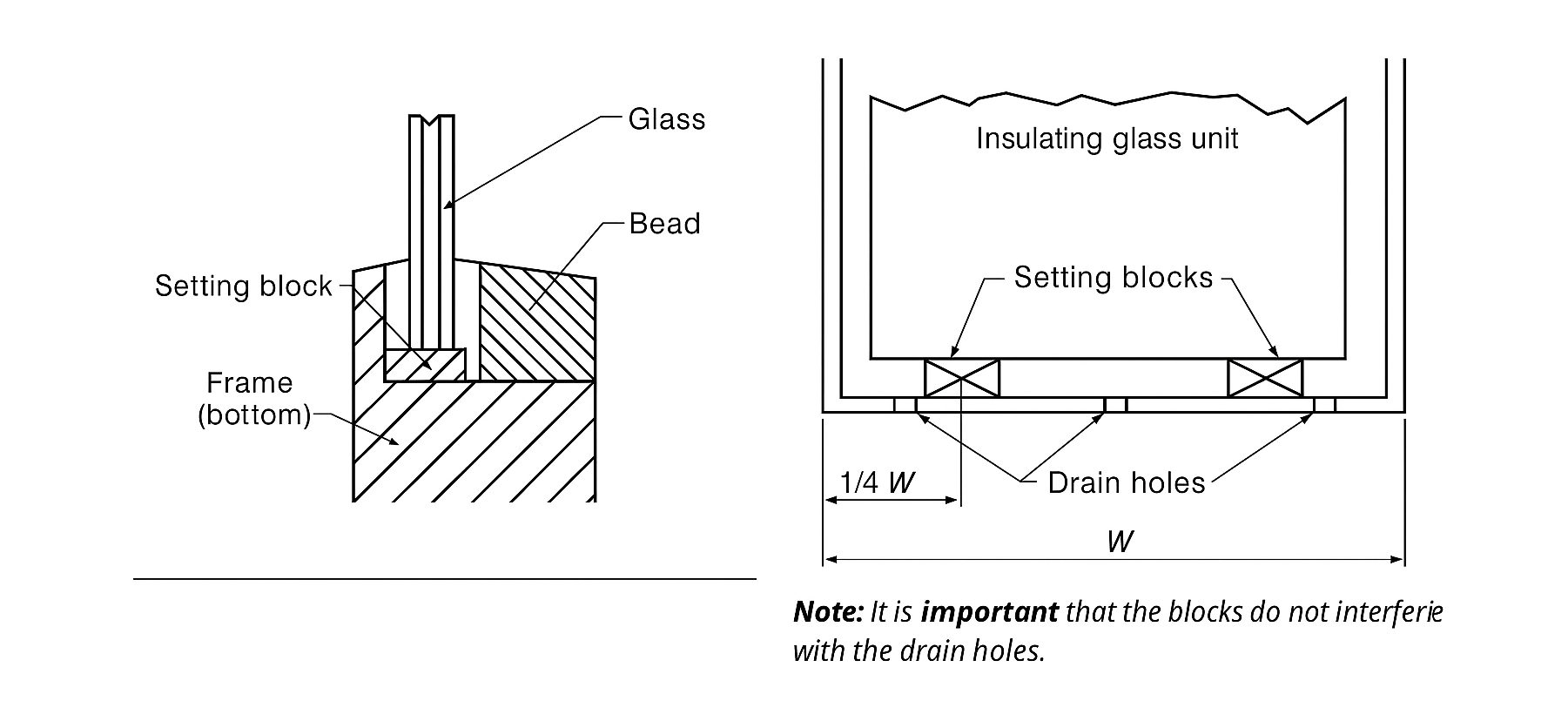
Drainage paths and weep holes must be clear and functional.
Glazing channels must be free of moisture, dirt, oil, and obstructions.
Avoid protruding screws or fasteners in the glazing channel.
Clearances & Support
Provide adequate edge clearance for the full IGU thickness.
Use setting blocks that allow water to drain freely to weep holes.
Prevent point loading on the glass.
Ensure a minimum edge cover of 12mm.
Sealing & Drainage Systems
Un-drained Systems
All external junctions between glass and frame must be fully sealed to prevent water ingress.
Sealants must maintain watertight integrity throughout the warranty period.
Moisture penetration can lead to vapor intrusion and seal failure.
Drained Systems
Design frames to prevent water pooling near the IGU edge.
Ensure drainage paths remain effective over time.
Avoid nails or sharp objects within the rebate.
Timber or concrete frames must be sealed with appropriate coatings before glazing.
Sealant Compatibility
Only use sealants that are compatible with the IGU’s secondary seal. A list of approved sealants for use with polysulfide and structural silicone systems is available from Novatec Glass upon request.
Un-Drained Systems
In systems without drainage (commonly found in timber frames), it is essential that all external junctions between the glass and frame are sealed to prevent water ingress:
Use glazing materials that maintain a watertight seal for the full duration of the IGU’s service life.
Prevent any moisture or water vapor from entering the glazing pocket, as this can compromise the perimeter seal and reduce the lifespan of the sealed airspace.
Drained Systems
For drained systems, proper water management is critical to avoid prolonged exposure of the IGU edge to moisture:
Ensure IGUs are installed in a way that prevents water pooling near the edge seal.
Frame rebates must be well drained and remain functional throughout the life of the unit.
Avoid placing nails, screws, or other obstructions within the rebate area.
Timber or concrete frames in contact with glazing compounds must be fully sealed with a compatible protective coating.
A list of approved sealants for use with polysulfide and structural silicone edge seals is available from Novatec Glass upon request. Always confirm compatibility before use.
Setting Blocks
Proper support of the IGU within the frame is essential to prevent stress and ensure long-term performance:
IGUs must rest on two full-width setting blocks, centrally located at the bottom edge.
Blocks should be at least the full unit thickness + 3mm in width.
Use non-absorbent, resilient materials such as neoprene, santoprene, or EPDM with a hardness of 85 ±5 Shore A.
Minimum block thickness:
3mm for residential applications
6mm for commercial applications
Minimum block length:
25mm per square metre of glass area
50mm minimum length regardless of size
Blocks should be placed:
150mm from each corner or ¼ of the frame length in, whichever is greater
Directly over pivot points for pivot sashes
Ensure block composition is compatible with the IGU edge seal.
Environmental Conditions
- UV Protection: Polysulfide edge seals must be protected from UV exposure. If the edge seal is exposed to sunlight, specify structural silicone seals designed for external use.
- Chemical Exposure: IGUs must not be exposed to chemical fumes, vapors, or gases beyond those found in clean atmospheric air.
- Radiation: Avoid exposure to any form of radiation other than natural sunlight.
Important Notes on Warranty & Moisture Management
All Novatec IGUs are covered under warranty for manufacturing defects (refer to warranty document).
If internal condensation or seal failure is observed, an investigation must determine the cause.
In drained systems, any moisture must have a clear path to exit the frame. This must be demonstrable during inspection.
In un-drained systems, removal of glazing beads and seals must reveal dry internal glazing pockets. Any signs of moisture may indicate improper installation.
Prolonged exposure of the edge seal to moisture or vapor—due to incorrect installation—will void the product warranty.